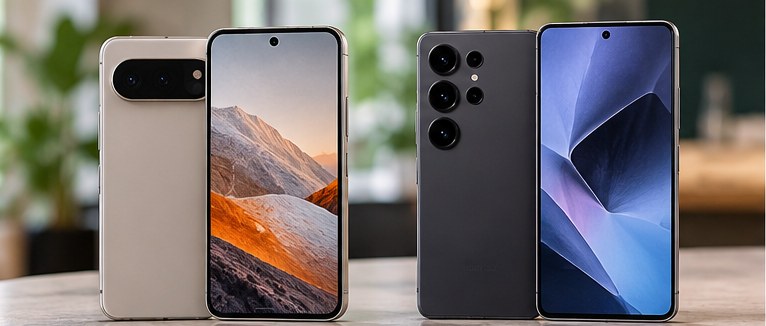
Pixel 11 and Galaxy S26 are easy to compare badly. They are both compact Android flagships with high-refresh OLED screens, multiple cameras and a growing list of AI features. That makes the spec sheets look similar. The buying experience is less similar.
Google's Pixel 11 is built around Google's version of Android, the Tensor G6 processor and camera features such as Magic Capture. Samsung's Galaxy S26 uses its own One UI software and, in the U.S., the Snapdragon 8 Elite Gen 5 for Galaxy. Official specifications put both standard models at 6.3 inches. [1][2]
If you're choosing between them, don't start with the AI demonstrations. Start with the four things that will affect you every day: software, camera behavior, battery and performance.
Pixel 11 is the simpler software choice
The Pixel's appeal is partly that Google's hardware and software are designed together. You get Android as Google intends it, Google's camera processing and the newest Pixel-specific features without Samsung's additional layer of apps and settings.
That does not automatically make Pixel software better. Samsung's One UI gives you more customization, more multi-window tools and a deeper set of Galaxy-specific features. If you already use a Galaxy Watch, Samsung tablet or DeX, staying with Galaxy can reduce friction.
Think about what you already know. A buyer who has used Samsung phones for years should not discount the value of familiar menus, photo behavior and accessories. A buyer who dislikes duplicate apps or wants a cleaner Google-first experience has a reason to prefer Pixel.
The camera decision is about behavior, not megapixels
Google lists a 48-megapixel main camera, 13-megapixel ultrawide and 10.8-megapixel 5x telephoto on the Pixel 11. Samsung lists a 50-megapixel main camera, 12-megapixel ultrawide and 10-megapixel 3x telephoto on the Galaxy S26. [1][2]
Those numbers don't tell you which photos you'll prefer. Pixel processing has traditionally made the camera a major reason to buy a Google phone, and Pixel 11 adds creator-oriented tools including Magic Capture. Tom's Guide found that feature useful even while criticizing the phone's modest year-over-year hardware gains. [3]
Samsung's advantage is flexibility and speed. The S26 also gives you a mature camera app and stronger processor performance for gaming and heavier work. If you photograph kids, pets or travel, look at actual sample photos rather than the sensor count.
Samsung has the performance advantage
Independent testing of Pixel 11 shows Tensor G6 trailing the Galaxy S26 in conventional CPU and graphics benchmarks. [3] That matters most if you play demanding games, edit video or keep a phone long enough that extra performance headroom becomes useful.
For messaging, maps, banking and ordinary photography, both are fast enough. Buying the benchmark winner is unnecessary if your workload never reaches it.
Google uses Tensor partly to support its own AI and camera pipeline. Samsung's Snapdragon-based approach gives the S26 stronger raw performance. Decide which kind of strength matters to you.
Battery is closer than the capacity numbers suggest
Google lists a typical 4,985 mAh battery for Pixel 11. Samsung lists 4,300 mAh for Galaxy S26. [1][2] Capacity alone does not predict runtime because the display, processor, modem and software all affect consumption.
Tom's Guide measured 12 hours 45 minutes for the Pixel 11 and 11 hours 28 minutes for the Galaxy S26 in its standardized battery test. [3] Treat those as comparative lab results, not promises about your day.
Both should get many users through an ordinary day. If battery anxiety is one of your main reasons for upgrading, compare larger models too rather than assuming the standard flagship is your best option.
The price should decide close calls
Phone pricing is unusually fluid in 2026 because manufacturer discounts, carrier credits and trade-ins can move the effective cost by hundreds of dollars. Compare the amount you will actually pay, including any plan requirement.
At similar prices, Pixel 11 makes the most sense for someone who values Google's camera and software experience. Galaxy S26 is the stronger fit for a performance-heavy user or someone already invested in Samsung's ecosystem.
If one is substantially cheaper without locking you into a more expensive wireless plan, that can matter more than a small feature advantage. These phones are close enough that a good price is a legitimate deciding factor.
Sources
[1] Google Store, Pixel 11 specifications.
[2] Samsung, Galaxy S26 series specifications and announcement.
[3] Tom's Guide, Google Pixel 11 review, Aug. 27, 2026.