Foldable phones have reached the point where the question is no longer whether the hinge works. The better question is whether the extra screen changes enough of your daily use to justify the price.
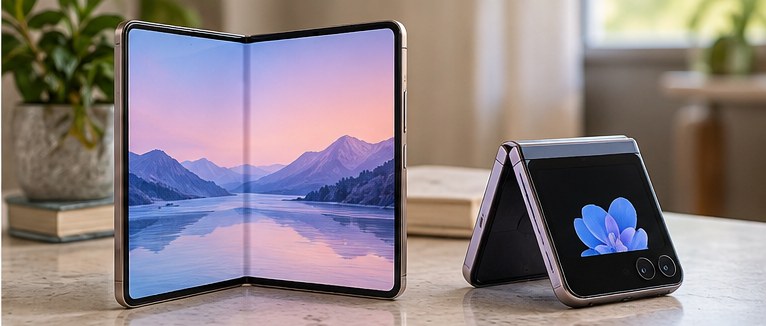
Samsung's 2026 Galaxy Z Fold8 is lighter than earlier book-style folds and uses a wider shape designed to make the outside screen feel more natural. Motorola's Razr Ultra 2026 takes the opposite approach: it folds a conventional phone into a smaller square and gives you a large outside display for quick tasks. [1][2]
Book-style folds make sense for multitaskers
The Galaxy Z Fold8 opens to a 7.6-inch inner screen. Samsung emphasizes its 4:3 unfolded aspect ratio and multi-window tools. [1] That is useful when you actually put two or three apps on screen, read large documents, handle email next to a calendar or watch video while doing something else.
If you mostly use one app at a time, the benefit can shrink quickly. You are carrying a more complex phone and paying a premium to gain a tablet-like mode you may rarely open.
App layout is still part of the compromise. Tom's Guide noted that the Fold8's new dimensions are better, while app scaling and adaptation remain an issue across foldables. [3]
Flip phones solve a different problem
A flip-style phone such as Motorola's Razr Ultra 2026 is about portability and quick interaction. Its external display can handle notifications, music, navigation and many short tasks without opening the phone. Motorola lists a 4-inch cover display and a 7-inch internal display. [2]
The appeal is physical. A tall phone becomes much smaller in a pocket or bag. The tradeoff is that you still open it for many ordinary tasks, and the hinge adds another moving part.
Motorola also pushes battery capacity harder than earlier flip designs. Independent testing found strong endurance for the 2026 Razr Ultra, although its high price makes discounted earlier models worth comparing. [4]
Durability is better, but the category still requires care
Modern foldables are much less experimental than the first generation. Samsung lists stronger materials and an IP48 rating for Fold8. Motorola also lists IP48 protection for Razr Ultra. [2][5]
IP48 is not the same thing as the IP68 rating common on many conventional flagships. Foldable displays also use a layered flexible construction rather than the rigid glass surface you are accustomed to on a normal phone.
If your phone routinely lives around sand, construction dust or rough outdoor use, a conventional flagship still has an easier durability argument.
The camera compromise has narrowed, not disappeared
The Galaxy Z Fold8 uses 50-megapixel wide and ultra-wide cameras, but the standard Fold8 is not built around long telephoto photography. [5] Motorola's Razr Ultra uses dual 50-megapixel rear cameras. [2]
That is enough hardware for good everyday photography, but the best conventional camera phones can still give you more lens flexibility for the money. If photography is your top priority, compare the foldable to a similarly priced slab phone, not merely to last year's foldable.
Buy a foldable for the form factor, not novelty
The strongest reason to buy Fold8 is that you genuinely want a small tablet in your pocket. The strongest reason to buy Razr Ultra is that you genuinely want a full-size phone that folds into a smaller object.
Neither is a rational purchase if the folding action itself is the main attraction. Novelty fades. The extra screen, multitasking or smaller folded size has to keep earning its place after the first week.
Before buying, spend ten minutes using the outside screen with one hand, opening and closing the device, typing on the inside screen and moving between apps. Foldables are physical products in a way ordinary phones are not. Fit matters.
Sources
[1] Samsung, Galaxy Z Fold8 introduction.
[2] Motorola, Razr Ultra specifications.
[3] Tom's Guide, Galaxy Z Fold8 app-scaling analysis.
[4] Tom's Guide, Motorola Razr Ultra 2026 review.
[5] Samsung, Galaxy Z Fold8 specifications comparison.