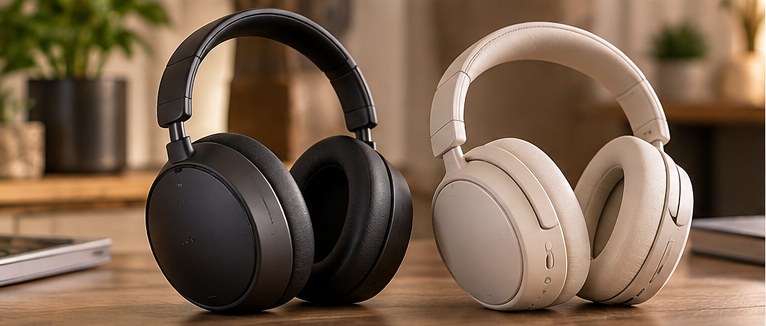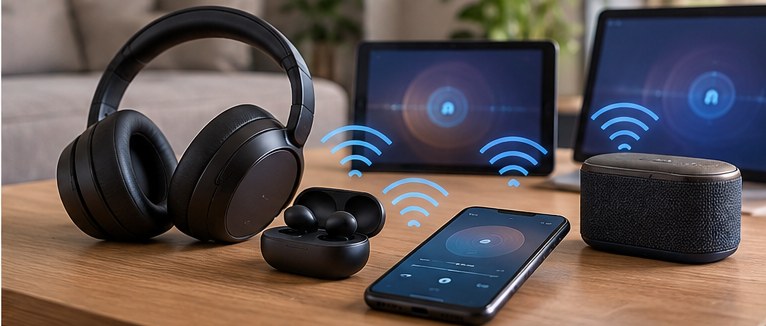
Bluetooth has usually meant one source talking to one pair of headphones or speaker. Auracast changes that model. A compatible transmitter can broadcast audio that multiple nearby receivers can join.
The Bluetooth Special Interest Group describes Auracast as part of Bluetooth LE Audio. A transmitter advertises a broadcast, an assistant device helps a listener find it, and compatible receivers such as earbuds, headphones or hearing devices join the stream. [1]
Think of it more like joining Wi-Fi than pairing headphones
The user experience is intended to look more like choosing a nearby network or channel. An Auracast assistant scans for broadcasts and presents them for selection. The receiver then gets the information needed to join. [1]
That matters because the transmitter does not have to maintain an individual point-to-point audio connection with every listener. Bluetooth SIG says an unlimited number of in-range receivers can join a broadcast. [2]
Public televisions are the obvious use case
Imagine a muted television in an airport, gym or waiting room. Instead of reading captions from across the room, a compatible phone and earbuds could let you join the TV's audio stream.
The same model can work for conference audio, museum tours, public announcements and shared listening. Bluetooth SIG also positions Auracast as an important assistive-listening technology. [3]
That accessibility angle is more important than the novelty of sharing a playlist. A public venue could broadcast directly to compatible hearing devices rather than relying only on older loop systems.
Having Bluetooth 5.x does not automatically mean Auracast
This is the compatibility trap. LE Audio depends on features introduced with Bluetooth 5.2, but a device with Bluetooth 5.2 or later is not automatically an Auracast product. Manufacturers still have to implement the required profiles and software. [4]
Before buying headphones specifically for Auracast, look for explicit support from the manufacturer. Do not infer it from a Bluetooth version number on the box.
Support can also arrive through firmware. Bose, for example, began adding LE Audio and Auracast beta support to its second-generation QuietComfort Ultra Headphones in 2026. That is a sign of the ecosystem expanding, but it also shows why current software version matters.
LE Audio is broader than Auracast
Auracast is one feature of LE Audio. LE Audio also introduces the LC3 codec and new ways of coordinating multiple audio streams. [4]
For buyers, that means “LE Audio” and “Auracast” should not be treated as interchangeable labels. A device can support parts of the LE Audio system without supporting every use case you have in mind.
Should you buy around Auracast today?
If you are replacing headphones anyway, explicit Auracast support is a useful future-facing feature, especially if you use hearing devices, spend time in public venues or like the idea of shared TV audio.
It is not a good reason by itself to replace headphones you already like. The public infrastructure still has to exist around you, and the transmitter, assistant and receiver all need compatible support.
Buy the headphones for fit, sound, battery and noise cancellation first. Treat Auracast as a feature that may become more useful over the life of the product.
Sources
[1] Bluetooth SIG, How Auracast works.
[2] Bluetooth SIG, Auracast overview.
[3] Bluetooth SIG, Bluetooth LE Audio overview.
[4] Bluetooth SIG, LE Audio FAQ.